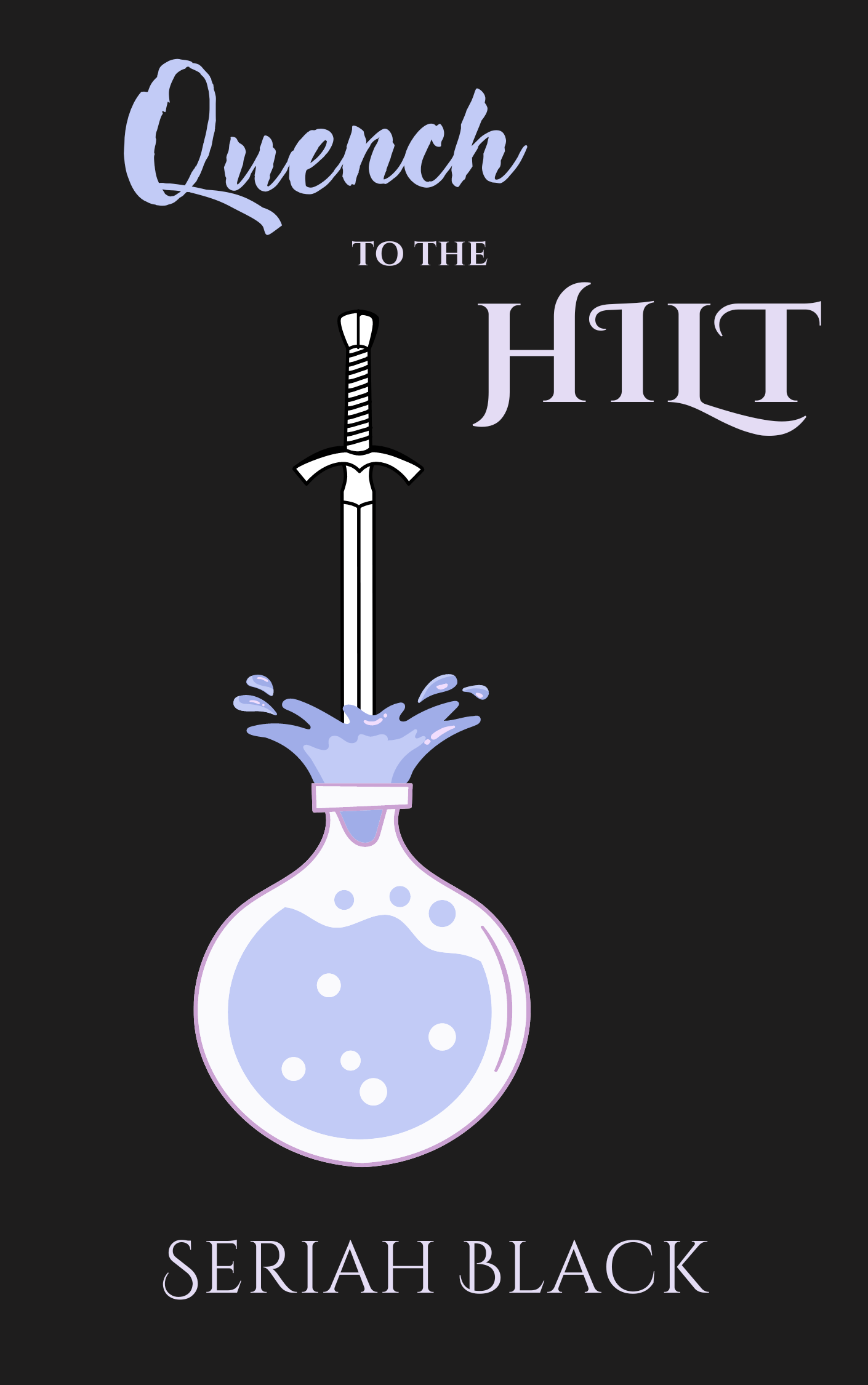
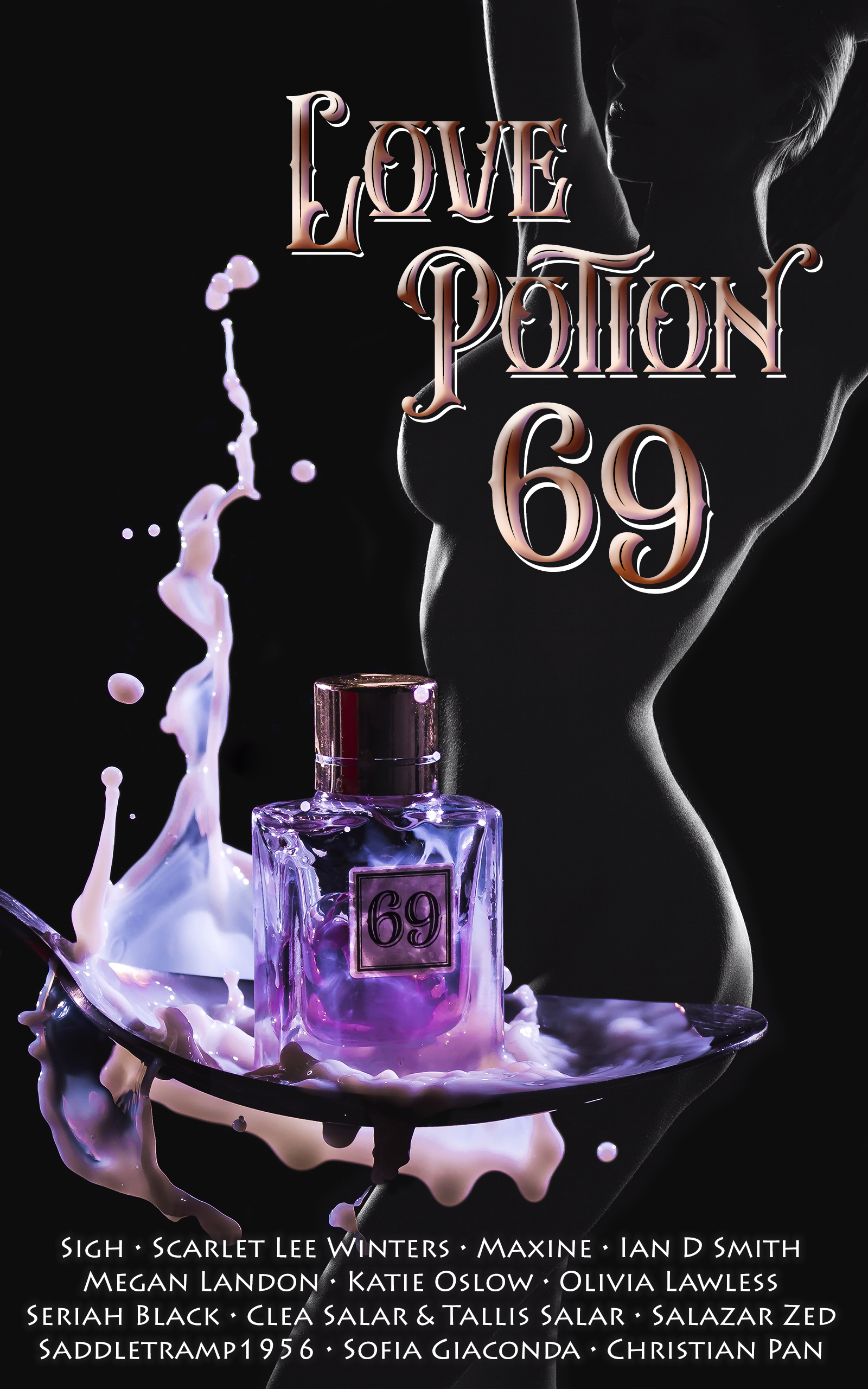
“Quench to the Hilt” is now available to read on Amazon! For a limited time, you can download the anthology it’s in as part of Kindle Unlimited. You have only a couple months left to do so! Otherwise, you’ll need to buy the e-book or order the paperback. I may publish an epilogue later, so make sure you have read it before then!
“Quench to the Hilt” is the last story in the anthology. Go get your blacksmith hippo shifter x dark hero love! Extreme heat awaits.
Originally, this story was going to be contributed to an anthology this year. However, the anthology date has been pushed back past the end of the year, and the dragonfly story continues to evolve. It’s unclear whether this story will grow from novelette into novella length. If it becomes a novella, it may be queried to publishers instead.
Let this Bard and Dragon Rock You
We’ve seen plenty of fire-breathing dragons, but what about dragons of the other elements? Enter Theodyne, a rock dragon hybrid with a stony secret.
Don’t miss that there are two stories in this sequence, coming out back-to-back this fall!
Look for a Countdown to Part 1 at the End of August.
Get Yourself Snowed In
Ready for the sweaty weather to finally cool down? This winter, dig into a different kind of heat in the snowstorm with a yeti shifter. More info to come.
I’m excited to share I will be releasing two stories in new worlds with new characters this year (2024).
Last year, I released MAN OF MANY SMILES, the first of two Amagladeus x Kitiora pairing short stories running concurrent within the larger Beastking Chronicles series.
The story was published in Seattle Erotic Art Festival’s literary anthology for 2023.
Break into a world of treetop clan battles and castle captivity as one member of the evolved hummingbird race fights against the clock to uncover why her people keep disappearing into the recesses of the dragonfly castle. The future holds the key to the past, but the enemy commander may be the only path to the future.
This story will likely be published in an anthology.
Enemies-to-lovers, implied time travel, high fantasy, dark fantasy, dark romance, pseudo-monster romance, pseudo-shifters, hybrids, forced proximity, warring clans, prisoner of war, magic mirror, interracial/humanoid interspecies, dub-con
You may like this if you like: humanoid shifters, winged people, beauty and the beast castle, captive dark romance, parallel dimensions romance, time paradoxes, Green Goblin-like armor
Blacksmiths service heroes, but this hero is getting more than he bargained for when he hands a blacksmith apprentice his sword. Turns out there’s more than one way to quench a blade, and a love potion more than does the trick. Commissioned on a side quest under the influence of the blacksmith’s potion, what at first looks to the hero like a break from the snotty heroine on his own quest has him side-questing into a whirlwind of trysts with the wrong type of woman for a hero.
This story will be published in an anthology with other erotic stories.
Love potion, dub-con, side quest, high fantasy, erotic romance, erotic fantasy
You may like this if you like: heroic journey spinoffs, isekai, unconventional shifters, monster fighting, quest-based fantasy anime, role-play games, “grease monkey” heroine
If news here seemed quiet in the last several months, it’s because multiple things are brewing.
1. Increased Writing Community
I joined some really great writing organizations and Discords, including Passionate Ink, an erotica consortium, and San Joaquin Valley Writers. I’m also volunteering at the Fantasy, Futuristic and Paranormal Romance Chapter (FF&P) of RWA to get to know the other members better and learn how not to bore you to death if and when I start a newsletter of my own. Let me know in the comments whether you’d be interested in reading a newsletter from me, and what you hope might be in it.
I’ve been attending a ridiculous number of writing workshops. Most writers with whom I’ve become acquainted say I’m doing to much. I say I’m doing what is necessary to get my stories to you as the best those stories can be.
2. Attempted Poetry
(Not to Be Confused with Attempted Murder…Sort of)
Last year’s AWP conference exposed me to fantasy fiction poetry (vs. prose). I was starstruck. I’d read Beowulf and Ovid’s Metamorphoses, so I’d seen some epic fantasy- and mythology-type poetry before. But I didn’t realize there were poets today writing erotic fantasy mythological poetry like Rebecca Lehmann’s “Nike, Medusa, Jocasta, Split.” A little further reading into some online poetry databases and journals, however, revealed that many didn’t have a non-mythology category for fantasy poetry. Weird, right? Since when was that restricted? A recommended poetry book tried to get me to write about the dishes in my sink instead. No thanks. If I wanted real life, I’d stick my nose outside, not in a book. I’m sure Bre’s dishes are way more interesting than mine.
There was another motivation, too. It’s the one we fantasy writers don’t talk about. There’s this horrible thing that happens when a fantasy writer who’s definitely not a poet tries to write a fantasy prophecy. They pretend to be a poet, but something really lame comes out. I needed that not to be me. Rrohm has too many prophecies surrounding him for them to look like I played with a crossword puzzle and hoped for the best.
So, I attempted poetry. I’m not saying it was particularly good poetry. (My instructor and fellow workshoppers were kind, but I have no delusions of grandeur.) However, some BeastKing Chronicles things and some non-BeastKing things came out, along with the buriable real-life things. I started to wonder if a BeastKing Chronicles fictional poem could make it into a newsletter that I send out. Would that be a terrible idea?
Maybe that depends on how terrible my poetry is.
3. Attempted Short Stories
My short stories are breeding like crazy, and they’re coming out faster than I know where to put them. I was always a one-project person, but now I have many. The good news is they will get to you faster than BeastKing Chronicles, and some of them are running parallel to the BeastKing Chronicles plot about three books in. That’s right, I said three. I know you haven’t seen book 3 yet. At all. It has a guaranteed existence. It’s just in the rugrat stages right now. If you don’t mind a little bit of a spoiler, Kitiora has a story you can read in last year’s Seattle Erotic Art Festival’s literary anthology. The sequel is out on query, along with another non-BeastKing story.
Exciting news: Two other, longer short stories I am working on will be coming out this year for sure. One is an enemies-to-lovers dragonfly- and hummingbird-shifter time travel romance with a sordid castle and a dark, magic mirror. The other is a heroic-reversal love potion story where a blacksmith ropes a hero into doing her side quest and gets a bit more sexual tension than either knows what to do with. They’ll have some of the tones and power plays of BeastKing Chronicles, but are completely new stories in their own worlds. So if you’re interested in BeastKing Chronicles, you may enjoy these stories as well. As always, I’ll be bringing you an antihero to remember and a heat level to make you trip in your socks.
As a caveat, I do also have a few stories rolling out that will not have a heat level at all. You’ll still get all the surly antihero goodness, deep characters, special abilities, and otherworldly adventure. You just won’t feel like you’re getting heatstroke from mating heat. If you’re not sure how that would work based on my writing style, you’ll just have to come see for yourself.
4. A Thing Called a Website
As short stories continue to roll out into the public eye, and as I continue to prep BeastKing Chronicles and Salty, With a Taste of Dragon for querying, I’ll be updating this site to reflect that. One change already is the domain. Next steps will be taking more control over the way images and information on the site are laid out.
Perhaps the most exciting will be the addition of cover designs and/or short story emblems. In an era where stock photos amass, and photo credits and AI-generated images have become major concerns, I think it’s time I updated all the graphics on my website. I am scoping out artists, paying for images I can mutate, and learning the most basic of cover designing techniques. Many of my stories have mature and/or graphic content, and I think it’s very important that the cover images representing those stories stay classy and not the kind I would want to hide if small children were running by or my boss were to find me reading my new purchase in a Barnes & Noble café. I’ve been that person ducking behind shelves in the romance aisle, embarrassed that that dude over there saw me surrounded by poster equivalents of suave shirtless men. I’m not doing that to you, as far as I can help it.
Another exciting development is I’m drawing up new maps for BeastKing Chronicles. Or rather, it’s on my list to do. Say goodbye to the days of maps made in Paint. And feel free to point me in the direction of an ink artist/cartographer who does fantasy maps. I don’t want mine to look like I dropped you into a pixely video game dungeon.
Much like I’m no expert poet, I’m also not a professional web designer or graphic artist, so please bear with me as I navigate image licensures, commissions, and best practices.
As mentioned in yesterday’s post, another potential website update is in blog content. I am considering doing a mini series on uncommonly discussed niche writing tropes and sub-genres.
I am still on X, but I have also recently created social media accounts on BlueSky and Instagram. I will add links once they are properly set up. Many author guest speakers I have encountered over the last year are on BlueSky, and I’m glad to join them. However, it may be best not to expect a whole lot out of me on Insta until I have story trailers or something to share. That may be a while. Until then, all you’ll probably get out of me is DIY home library stuff, and maybe excited anthology cover photo shoots.
I’m thinking of doing a mini series on writing tropes or sub-genres that have been underrepresented.
What do I mean by that?
Previously, I blogged about how difficult it was to find articles on writing revenge romance. Recently, another writer confided how difficult it is for her to research her niche of cozy fantasy. I replied with how difficult it has been for me to research what type of plot pattern a good mystery needs to have, for my mystery subplot. In addition, there is an entire taboo category of romance and dark romance that gets ignored unless you’re in the right reader Facebook group. Yet, these are obviously categories many readers camp in.
Which would be fine, if we were actually teaching people how to write these things. But who can I approach to teach me how to drop mystery hints when my protagonist is not a self-proclaimed sleuth, or how far is too far in rawness in an erotic romance scene? Who can teach me how to keep readers from hating my antihero who wants revenge on the heroine, when she does not want revenge on him? What about showing and not telling, when showing is graphic, or how to write in rich metaphor without overusing “like” and “as”?
You were going to answer, “Find a how-to writing book or article,” weren’t you. (Or use software to nitpick individual words.)
Except, we have a problem: How-to books these days aren’t even what university teachers are recommending. That’s because they are so general that they rarely help other than making a writer sometimes feel less alone in the process. Which is what writing community is for, by the way. Find a workshop. Find a Discord. Find a local group. Something. Anything. Use an online search engine before you say you can’t.
I have several how-to books on my shelf. The issue isn’t that how-to books exist. The issue is that people describe the same elements and repackage them with a different cover. Plot, dialogue, character, and setting are staples. You cannot promise me YA-specific content, or NA-specific content, and then tell me all the generalized content about stories that I already know, and place a line at the end saying, “You should read books in this category to see what’s the norm.” No. That’s why I bought your book. Tell me what I’m looking for. Tell me something other than how teenagers might call me out for trying to be hip. I live in real life; I’ve already seen that. I’ve been that teen. Tell me how to craft voice when I have a younger character. Don’t chicken out because you’re an adult and you’re winging it.
There is a deficit on our bookshelves and online and on our e-readers. The topics that we very clearly need sensitivity readers for are the topics that I have a 10% chance of getting in a workshop once in two years, and almost no chance of getting anywhere else. DEI is not the only thing that got buried.
If you’re like me, in that hole, trying to research and coming up empty, I can’t give you expert advice.
What I can do is start a blog where I share what actually helps me from my search, as I’m searching. Maybe that will jumpstart your own blocked search. Maybe it will spark someone who actually is an expert in one of these categories to do more than regurgitate how important it is to have a plot, have three sections, and save a cat. Those books have already been written. We need your help with new specifics, please. We need your techniques.
Don’t worry; our writing won’t come out like yours if we’re using your technique. We’ve got our own quirks to apply your techniques to.
We talk about “writers lifts” on social media, but isn’t a true lift when we give each other the tools we’re missing, so the rare manuscript gems that are challenging us the most actually get into readers’ hands?
Since when was the status quo fun to write for books?
Let’s write what needs to be written.
I want to pause and say to the many workshop and webinar instructors and speakers I’ve been sitting under for the past two years, and earlier than that: Thank you. Thank you for taking the time and covering the difficult topics, for providing the one-sentence takeaways that I’d been searching three years to find, for answering a dozen questions in a row, for not turning away our difficult and messy endeavors and our crayon-drawing-equivalents of addressing writing prompts and trying out your techniques. It took me a long time to find workshops like yours, and I recommend them to many other writers. I can’t say they all step up to try to tackle such big ideas, but I hope in the future they will.
What do you do when you realize your antihero’s revenge isn’t just an embellishment, it’s the plot of your novel?
Why, look up revenge plotting resources, to make sure you hit all the main points, of course. Until you find out there aren’t any.
Revenge is a trope readers and viewers know well. Classic examples are William Shakespeare’s Hamlet, the Jason Bourne movie series, and the TV show, Revenge. Clearly, the revenge trope can overtake an entire plot. So, why has no one converted the Hero’s Journey or the traditional plot arc into a map for writers to follow?
My best guess is it’s because revenge is an emotional motivation, and most people aren’t brave enough or foolish enough to try to logic out a string of emotions into a plan. Yet, isn’t that the essence of a revenge story? Isn’t that what the protagonist is doing in their head every step of the way?
The setup only gets worse when you’re writing a Revenge Romance. How can the setup of a known trope, in such a definitive genre, be so blurry?
Here is what articles have said:
Essential Archetypes: Victim, Villain, Avenger
The protagonist has to become an outlaw for the sake of revenge
The Victim died
The law doesn’t work; justice is not served
The Victim’s death is the inciting incident
Show the hero’s normal life before the victimizing event
Make the reader feel like the protagonist is in the right and their actions are justified, even if not admirable
Revenge plots are a function of Thrillers
Use the Villain as a foil to the Avenger
Successful revenge ends in death, likely for the protagonist
I’m no expert, but those points seem to be ignoring some things.
Here’s why that doesn’t work:
The offender (Villain) is now an unwitting Victim
The Avenger is the Victim, and is turning into the Villain of another character’s story
A non-Avenger Victim doesn’t have to be dead; they could be kidnapped, they could have been forced to marry another, they could be seriously impaired mentally or physically, or they could have gotten over their trauma in a way the Avenger cannot
Revenge tropes show up in every genre, with Science Fiction, Fantasy, and Romance in particular inviting revenge as a motivator
An administrator of Law could use the law to take revenge
Justice could be served by another character, but the Avenger’s grudge is personal and therefore not resolved
As proven by the Revenge TV series, revenge may be most effective when working from within, rather than being hindered by outlaw status
Depicting the Avenger’s lost normal life at the beginning of the novel might mean starting the story too early, which is the bane of publishers’ existence and not why readers are picking up a revenge novel; you’re just giving people something to skip
Killing off the protagonist in a Revenge Romance makes the story a Tragedy
If the Avenger is set up to get revenge on their not-yet-Love-Interest, the ending may not be satisfying, and may even undercut the rest of the story’s progression
If you have to convince the reader that your morally grey Avenger is serving true justice, they’re not; revenge is about personal satisfaction from within one’s own means and an attempt at practical closure, not about the existence and efficacy of justice as an abstract idea
Enemies-to-Lovers makes this theory crumble to pieces
Every time I have mentioned Revenge Romance, somebody asks if I meant Enemies to Lovers.
No, I did not. I said what I meant.
Revenge Romance vs. Enemies to Lovers
Enemies to Lovers implies each party sees the other as an enemy to get revenge upon. Mutual destruction is assured, unless one bests the other first or both fall in love simultaneously. Think Romeo and Juliet.
Revenge Romance only necessitates one party see the other as an enemy. One character could be blissfully unaware that the other is targeting them, or could have no desire to fight the Avenger even when antagonized. There is also a greater likelihood that revenge methods could be curbed by slowly-softening characters to lead to more humiliating, more redemptive, less lethal solutions.
I’ve begun reading Shanna by Kathleen Woodiwiss to explore this a bit deeper.
Revenge Romance in BKC
If you were helping me critique The BeastKing Chronicles previously, you probably noticed that Rome pulled some jerk moves because he was self-consumed and misguided. But sometimes, those motives were also skewed as a response to what Labriella had done to him in the past.
In the first couple versions of the story, Rome came out hot tempered and emotionally resistant, while still thinking sensually. His temper, and his catch-and-release cycle, drove Labriella nuts and stunted the story progression. The next couple versions of the story integrated the suddenness of a predator who waits, then snarls and suddenly pounces. Anybody would be afraid of a predator, even an old childhood friend, and so is Labriella, though she still cares about the man she knows beneath.
But what came out, in the private moments between the two characters, was a tit-for-tat vie for acceptance of which of them was right about what their relationship should be. In the back of Rome’s mind was always the sight of Labriella’s back, fading into the distance, leaving him alone again, and the urge to make sure she paid for that mistake. As the story progressed, Rome’s tactics for making her pay backfired, and he found himself caught in his own trap with sensual desires he didn’t know could cripple him.
That may have been what was in the back of Rome’s mind, but in the back of my mind was the worry that it could take a whole book unto itself to reconcile Rome’s starting disposition with Labriella’s disposition toward him—possibly even a whole story arc. That was when I realized: Rome’s revenge mindset, or at least his initial hurt, needs to be dealt with before the end of the temple repossession arc. Book 1 already needed to be shortened. The best solution may be to let his revenge play out in Book 1…and bite him in the butt.
A growing concern in my mind over the years has been the increasing sense that Labriella, the semi-normal-perspectived main character, is a flat character. Most of that stemmed from having little to no interest in her. In the beginning, turning from a Damsel in Distress into a Damsel with a Kick was the main point of Bre’s origins and tendencies. Basically, she existed to show off Rome, and she was built to want to show off Rome.
But as any of my readers would readily tell you, Rome is not the type of guy to love a dunce just because she was there. Especially when she is the reason he hit rock-bottom for the second time in his long life, Rome would be more prone to kick the girl to the curb definitively than to wishy-wash back and forth with uncontrollable emotion over her exit. The magnitude of this is seen not only in Rome’s dealings with shopkeepers and employees, and with nobles, but also with the nobles’ showcases. A remote attraction to Kitiora can only be true if she has a brain, and the balls to kick him in them.
And yes, if you haven’t noticed, Bre’s concern over that last bit is grounded in reality, not jealous paranoia.
So, what is an author to do with a heroine who exists to be as unobtrusive to and un-hated by female readers as possible?
The first major recognition is that Bre lives in a world outside of my area of expertise. I do have professional ties to the medical world and service experience through prior employment. I know masseuses, nurses, and mushroom hunters. I now live in a wooded area. I grew up in a conservative religious culture. I have a family member who beat cancer post-surgery through homeopathic supplements and dietary changes. I have another family member who made burn cream in her backyard. But what do I really know about binding wounds, tinctures and tonics, poultices, and poisons? What about those “long-lost” apothecary skills? What about herbal remedies that aren’t attached to witchcraft?
Throughout (or despite, or because of) my long college career, I gradually found the opportunity to study some of these things: CPR, Wilderness First Aid, mushrooms and poisons books through inter-library loan and a co-worker, and tonics and tinctures through another co-worker, plus pheromonal experimental study results as they relate to psychology.
Today, I add to that study through a couple preliminary classes on Udemy about massage and herbs.
The amount of behind-the-scenes research we conduct, even as Fantasy or Romance authors, is amazing. Just because we can create our own world from scratch, doesn’t mean we aren’t cobbling together actual starting matter based on real-world principles.
It’s official: I must be the WORST Romance reader EVER!!!
I love Romance. I even welcome some of the nitty-gritty TMI stuff. So why is it that the last e-book sample I read, written by a respected romance author, prompted me to make gagging noises and chuck my Nook across the room?
In the writing community, everybody is always talking about HEAs (Happily Ever Afters). And when I come across samples like I just read, it all sounds so suave—even when it’s the detached prodigal son watching a prostitute leave his bed. Bad Boy, okay yeah, I can dig that. But don’t romanticize him. Give me all his rough edges. Let his roughness come across in the writing. Let me feel him. Not feel what “good girls” want him to be underneath from the get-go. I want him to be raw. I want him to be work to get through to.
The last thing I want to do is bash on fellow writers. Indeed, these people have massive followings, so they must be doing something right.
Or everybody is just used to their favorites.
I, for one, have been spoiled off the cultured, individualized character perspectives of fantasy novels (Teen/YA and otherwise) and manga, down to the things certain characters notice and the language they use—language which often grows and changes through the course of the book, as the character himself grows and changes. So when I start in on a stereotypical Romance novel, and everything reads across in the same smooth monotone, I start to skim. And skim. Until I realize: I’m going to be skimming through this whole book. And then I grunt and groan and flail and flop, because I thought I finally had that book that I was going to read all the way through, and enjoy—that one I’d stay up all night to finish. And instead, I got one I would have set back on the bookstore shelf.
Somehow, I’ve gone from my childhood habit of reading every book that I can get my hands on in my subject of interest, to garage-selling books I don’t like and rarely finishing any books at all.
They say that writers should read widely in their genre of choice. And that’s a nice idea. BUT what happens when you throw those “wide reads” across the room—repeatedly? What happens when that becomes the reason why you keep writing the unpublished manuscript you cart around from coffee shop to coffee shop?
At this point, I just want a good read. A good romance read, with fantasy elements, if at all possible. Something I wouldn’t push “snooze” through. It doesn’t have to be spectacular…just, not uniform. Not post-apocalyptic. Not exclusively science fiction. With realistic, non-sappy, non-bratty, non-stereotypical fictional characters. I mean, come on, this is the romance section, people! It shouldn’t be this hard to sell me on the male character. He doesn’t have to be a werewolf or a vampire. In fact, I’d prefer if he’s not. He just has to be special.
If you’ve read an adult romance-fantasy story that you absolutely fell in love with, feel free to leave a comment below and give it a shout-out! I don’t care if it has mature content, but I DO care if the sex is pointless; character development through sex is an art form. The story doesn’t have to have sex though, just decent romance with fantasy. So GO! List away! PLEASE! I’m dying of suaveness overdose and bad storytelling styles.
I’ve been trying to jump back into writing my story, and in so doing, I’ve had to come back to a method that I’ve employed time and time again. I thought maybe, for the sake of other writers who are in the same sort of situation, I should share some advice:
If you think you can jump back into your story after a length of absence, and pick it up right where you left off, don’t. You may be able to. But that’s not the problem. The problem is that you think you remember all that your characters have been through, but you don’t. You remember the facts, the events, the flat progression.
You don’t remember your characters’ feelings.
If you’re like me, the last thing you want to do is go back and reread all of your work thus far to give yourself a clue. It’s too time-consuming. You’ll be tempted to go back and do revisions instead of writing new material. Your writing style has changed since then, and you can’t match it.
My solution?
Take a piece of paper and a pen, and start jotting down the key points of what your characters have been through recently, in chronological order. If you’re totally clueless, you could try starting at the beginning. But if you were in the middle of writing a building-block scene or a significant event, start with the beginning of that event. For instance, I left off 4-5 days into a weeklong party in my story—a party which will have a rather drastic culmination. So I glanced over my chapter titles, and skim-scrolled down my story document from the first party chapter, and began writing bullet points of emotion-driving moments that stuck out as changes from the characters’ previous thoughts or actions.
In other words, I’m tracking character development through the most recent progression of events.
You don’t have to write down things like “he was angry” or “she was jealous,” but your bullet points should bring such things to mind when you see them. Like, “she saw him kissing another girl” brings to mind a bunch of emotions the character should be feeling (i.e. jealousy, loss, a sense of urgency to fix it, etc.).
The purpose of the bullet points is to bring your own emotional scale into line with that of your characters. You felt with them once. You need to feel with them again. If you saw your love interest kissing a girl who was a complete stranger at a party, you would feel ___. If someone offered a pleasant distraction from your girlfriend making out with another guy, you would be ___ if she condemned you for accepting it.
Do you see where I’m going with this?
It’s not enough to jump back into the plotline events. You have to realign yourself so you can breathe in sync with your characters. Only then can you feel out what needs to happen next to move things along.
I recently realized I hadn’t updated my Volume 1 info page. Whoops. Fixed that.
As I mentioned before, I’ve been dragging my heels in my writing a bit because I signed up for some online writing workshops.
“Do those really help?”
Yes and no. There’s always the stuff you already know from experience, the stuff you’ve already researched, and the stuff you can’t figure out how to assimilate. The farther along you are in your writing, the more narrowed your focus. For instance, I now know that I am writing an antihero (as opposed to a Prince Charming or an epic hero), and my Fantasy story’s plot decided it wants to be a Romance. So every time I read advice about what a hero should and shouldn’t have, and what they should and shouldn’t do, I’m seeing it through a Romance/Antihero lens. I take some things, and I toss the rest. What to take vs. what to toss is the pivotal question. My male counterpart is an Antihero, he’s discreetly muscled and slimly built, and I loathe irrelevant book covers, so I automatically dismiss the idea of having a book cover image depicting a headless muscly chest, and I’m going to ignore any advice on how to make him extra-fluffy lovable. On the other hand, he’s damaged with a past, I want readers to be sympathetic, and I’ve got to get my heroine (and my readers) to fall for him. So I’m more than happy to take advice about how to write in his sexy quirks every couple lines, and build questions and intrigue through his actions and reactions.
Information is what is helpful in these workshops. It’s authors handing you tools. It’s social connections. And it’s awareness of your contemporaries and the current book market.
Perspective is a totally different issue. The best perspective help I’ve had volunteered actually comes from readers in the genre, down to the subgenre and the sub-subgenre. There’s no substitute for it. Readers intrinsically know what they’re looking for in a subgenre—or rather, they can tell whether what they’re looking for is or isn’t present. Some readers will just drift away if they feel your story is lacking. But other readers will leave a line or two—or even a few paragraphs—if they know you’re interested in what they have to say.
So I’d like to say “thank you” to those readers who reviewed my most recent chapter, and those who have reviewed my story in the past. Also, a special “thank you” to those readers who reviewed multiple versions of my story. It is your comments I keep in mind when I revise, and when I try to figure out where to write to next. It is your comments that I use to write myself out of corners. And your comments have helped make me a better writer. Don’t think that your one little nay-saying comment is not heard inside a bunch of yay’s, or vice versa. I know I have cut scenes some of you liked, but don’t think I’ve deleted them. They’re still here, waiting to be added back in.
That being said, I am slowly realizing that all of my focus on the “right” ways to do things in order to get published has both helped and stunted my writing. I’ve been outlining and re-outlining, trying to figure out where to go next. That’s necessary, at certain stages. But I’m looking at two more events before the end of the second book, and realizing my writing went so much faster when I just free-wrote. Sure, I wrote myself into a bunch of corners. Sure, I had a bunch of adverbs and repetitive sentence structures. But I also chalked scenes full of emotion and used them as catalysts for unexpected plot turns…and I did it without hardly thinking about it. I just followed my pen. The next revision I have in mind for my manuscript is actually way closer to my original plot ideas, because my story has taken on a life of its own and thus far I have opted to blindly follow it, into whatever unexpected turmoil my pen may lead. I’m not sure which is better to publish: the original plot, or the raw, character-charged emotional turns of events. But with the end of the second book finally taking shape, I think I might just throw myself into it. After all, that’s where all the limes are going to hit the fan.
The second event at the end of this book, I was actually considering moving to the end of the first book. But now I’m not so sure. I guess I’ll figure it out after it’s written. After all, no matter which order events fall in for these two books, events in the next portion of the story should progress the same.
I don’t know if I will go right into writing and posting the next book after I finish Book 2. I might, if I have momentum. But it seems like a great breaking point for revisions.
Anyway, I’m finishing up a Male P.O.V. workshop by Sascha Illyvich (previously entitled “Inside the Male Mind”). I’m starting in on a Romance Writers of America workshop called “Killer Openings” by Alexa Bourne, which should help with the revisions I’ve been toying with for the beginning of my series. I’m also attending a one-night class on publishing and a seminar about characters this month. After those, my two-month workshop madness will be complete. It’s quite the marathon, and it can be difficult to switch back and forth between question mode, social mode, revision mode, and writing mode. Who knew authors had to be such multi-taskers? But after that, it should slow down…and my writing should pick back up. Theoretically.
Chapter 12 is underway; don’t think I’ve forgotten about it just ’cause I’m in a workshop frenzy. I’ve spent a lot of time mulling it over, attempting outlines, and brainstorming specific prospective scenes. I’m being careful, because recent discussions about bondage and alphas has helped me see how important it is that I handle the details of Lord Alonza’s party the right way. Rome may be dominant, but it is very important that you (my dear readers) see that his brand of dominance distinguishes itself that of the corrupt nobility—that they’re about a lot of things that he’s not. I believe the best way to do that is to stick Rome in a noble-dominant situation, and contrast his desires (and how he handles them) within the same situation.
I should warn you, though: Some bad crap is going to happen to Labriella. And, Sheryl, you’re right; Labriella has been growing more timid. But, if I play my cards right, the aftermath of said “bad crap” is going to change that. 😉
For months—maybe even over a year—I have been frustrated with my first book, because I could not find a plot in it. With all the fiction I’ve read over the course of my life, and all the stories read to me before I could even read, and all those classes where teachers made me analyze and chart plot structures, how in the world could I create a book without a plot?! The possibility had never even occurred to me. And once I began to scrutinize the possibility, I was even more disheartened to find it true. Because what else could be the problem?
But after my sixth attempt to outline my plot points—always getting stuck in the same place—I tried a new approach, and finally realized my problem. It’s not that I don’t have a plot. It’s that I have four plots running concurrently, and the primary focus is the romantic one, so no traditional plotline gets the limelight enough to emerge as the official identifiable plot. In fact, you might argue that all four of these plotlines are actually story arcs—meaning they span at least part of the series, rather than being resolved in a single book.
So if you’re a “pantser,” and you’re having trouble unearthing that plot that seems like it’s hiding or nonexistent, I suggest writing out a play-by-play outline, and then an extremely vague outline of points, and see if you can divide things up by topic.
If you can’t abide pinning down your work like that, write down your ideas in different colored pens, and then take a look at what kinds of things ended up in each color. Surprise! You’ve drawn yourself a mind map, and now all you need to do is draw up the key. That’s what I did. Sometimes you just need to look at your thoughts differently to understand what’s going on and roll with it.
These are my plots, as I discovered them when I tried separating them out into categories (as defined by the parties involved):
Pandora
Temple
Noble
Romance
I suppose I could split “Romance” again, into “Gian & Labriella” and “Rome & Labriella“…but I would actually prefer to stick with a triangular effect. I want to use Gian to enhance and/or force out a definition of Rome and Labriella’s relationship, and use the nobles (and Pandora, and the temple) to further force it out of the shadows. That probably means I need to scatter Gian’s parts throughout the timeline a bit more, instead of having so many chapters between him and Labriella in the first book.
In my case, does the solution to having four plots entail untangling those plots? Or maybe picking just one per book? Ummm….Ew. I mean, I could do that, but I wove all those plots together subconsciously for a reason; they add depth to one another. At first glance it appears that there is no plot, because you’re walking through the characters’ lives. It’s those elements in their lives that brought them together, and that make up all those plots. Each is a festering issue that needs to be dealt with–and each starts out very small.
Part of the reason I’m so set on revising my first book again, is because I want to resolve either the noble plot or the temple plot (or both) by the end of the first book. I now suspect the noble plot will be more of an undercurrent that will come to a head on several supporting occasions. So I’m fixing my attention on the temple plot. If I start book one with the temple, then I should end book one with the temple. Otherwise, Labriella being considered a “runaway” becomes old news and eventually feels buried or ignored.
Previously the first book revolved around the question of whether Rome would allow Labriella to stay with him. But a few of my readers complained that they were running so many insecure circles around one another that it was slowing down and lengthening the story. And I agree. At least one set of circumstances needs to be sealed in by the end of the first book.
I feel like I’m trying to cram in a lot of things. But maybe, if I eliminate lengthy descriptions, consolidate scenes, and get rid of reflective dialogue, I might still be able to shorten things up. After all, my goal for revising this time around is to keep the plot moving.







 So
So 
 Seriah Black